The Crunchiest Snack and the Wobbly Tower: Twelve Pick-Up Prompts for Under-Fives
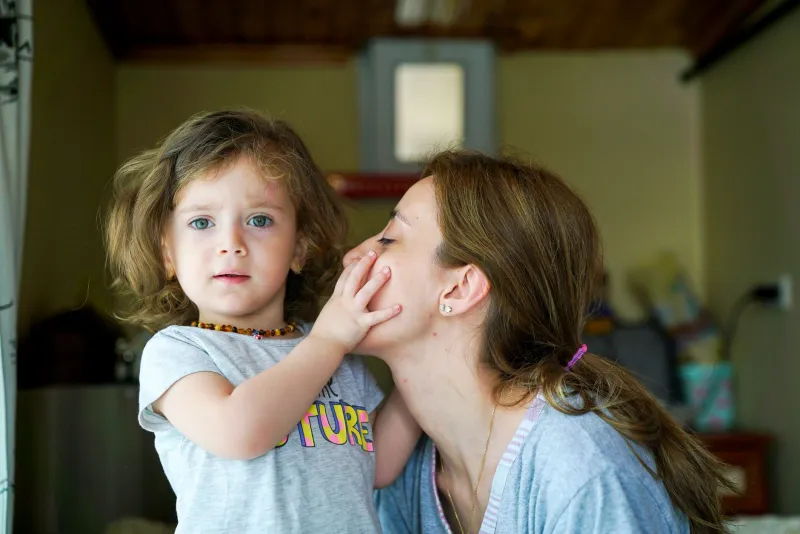
At the nursery gate, it often goes like this. You crouch down, coat in one hand, bag in the other, and ask the big question: 'Did you have a good day?' Your child looks at the floor, says 'yes', and asks for a biscuit. It can feel like a report has been withheld. But most under-fives are not being secretive. The question is simply too wide. A nursery day is made of small, physical, social moments — a wobbly tower, a snack that was too warm, a turn on the trike, a story read twice. 'Good' is an adult summary. A three-year-old needs a doorway, not a summary.
Here are twelve doorways. They are not a test. You do not need to work through them like a checklist. Pick one, ask it while you are walking or getting the buggy out, and let the answer be short. A single detail is a win.
Why the big question falls flat
Under-fives are still learning to file a day into a story. They remember what they touched, tasted, heard and felt. They may also be tired, hungry or still in nursery mode. Asking a broad question at the gate asks them to do several things at once: remember, summarise, find the words and manage the handover. That is a lot after a busy morning.
Concrete prompts do some of that work for them. A question about snack, the garden or the home corner gives a hook. It also shows that you know their day has a shape. Over time, this kind of chat supports language, memory and the beginnings of narrative — the 'first this, then that' thinking that later helps with reading and writing. It is not a lesson. It is just a smaller gate to walk through.
Start with the body, the bag and the biscuit
The easiest prompts are tied to something physical. At pick-up, your child has just come out of a room full of sensory detail. Use it.
-
What was the crunchiest thing at snack today? Crunchy, squishy, cold, warm — these are words small children can grab. You may get 'cucumber' or 'I don't know'. Both are fine. Follow up with 'Was it loud?' rather than 'Why don't you know?'
-
Did the garden feel muddy, crispy or puddle-y under your boots? Weather is a safe, shared topic. It also opens the door to what happened outside without asking 'What did you do?' — a question that often gets 'nothing'.
-
Which welly went on first this morning? This is a tiny routine question, but it can lead to a whole saga about zips, labels and the wrong foot. It also gives you a job: you can nod and keep walking.
Move to the home corner and the story rug
Nursery routines are familiar, and familiar stories are easier to recall. The home corner is where a lot of social play happens. Storytime is where language is shared.
-
Who was in the home corner today? Were you the cook or the customer? Role play gives children a ready-made script. If they say 'I was the dog', ask what the dog did. You are not quizzing; you are joining in.
-
What did you build that needed balancing? Blocks, boxes, Duplo, a tower of cups. 'Balancing' invites a story about the wobble and the fall. It also avoids the flat 'I played'.
-
Which story did you hear twice? At nursery, favourite books get read again and again. If your child says 'The Gruffalo' for the fourth week, that is not a dead end. Ask which page they liked, or which voice the grown-up did.
-
What made you laugh at the table? Snack and lunch are social. A silly face, a spilled water, a friend's joke — these are the bits children often remember. If they cannot think of one, offer your own silly moment from the day.
Add feelings, but keep them small
Big feeling questions — 'Were you happy?' — can be hard to answer. Small feeling questions are easier. They also help children notice and name emotions without making them the centre of an interview.
-
Was there a moment when you felt proud today? Proud is a useful word. It might be a zip, a drawing, a kind hand. If they shrug, try 'Was there a moment when you felt really big?' You may get 'when I put my shoes on'. That counts.
-
Did you need a grown-up's hand for anything? This normalises asking for help. It also gives you a gentle window into frustration or difficulty. If the answer is 'the slide', you can talk about the slide without turning it into a safety lecture at the gate.
-
Did you help anyone, or did someone help you? This is a community question. It nudges children to notice other people, which is part of nursery life. Keep it light. If they say 'no one', you can say 'I helped you with your coat just now. That counts.'
End with the last thing, not the whole day
The final prompts are about transitions. The end of the nursery day is often a blur, so ask about the last few minutes rather than the whole morning.
-
What was the last thing you did before you got your coat? This is specific and recent. It might be 'I put my cup away' or 'I did a poo'. Either way, it is a real answer.
-
Which song got stuck in your head today? Songs are sticky. If they sing a line, you can sing it back badly on the way home. That is often more useful than another question.
What to do when the answer is still a shrug
A shrug is not a failure. Some children need to run, snack or sit quietly before they can talk. Try asking one question in the car, one at teatime, or none at all. You can also narrate your own day in small details: 'My sock got wet at the bus stop. I had a crunchy apple.' Children often join in when they are not being asked directly.
If your child is consistently quiet at pick-up, or you are worried about something specific — a fall, a friendship, a change in eating or sleeping — speak to their key person. They see the day unfold and can fill in the gaps without putting your child on the spot. At Dryden Street Nursery, we would much rather you ask us than worry quietly at the gate. A quick word at drop-off or a message later is fine.
Try this tonight: Choose one prompt from the list — not twelve. Ask it while you are doing something else, like taking off shoes or buttering toast. Give your child a few seconds. If they answer with one word, repeat it back and add a small detail of your own. Then stop. The aim is a conversation habit, not a full debrief.
The walk home does not need to be a full report. A single detail — the crunchiest snack, the wobbly tower, the welly that went on the wrong foot — is enough to say: I see your day. That is often the conversation starter they need.